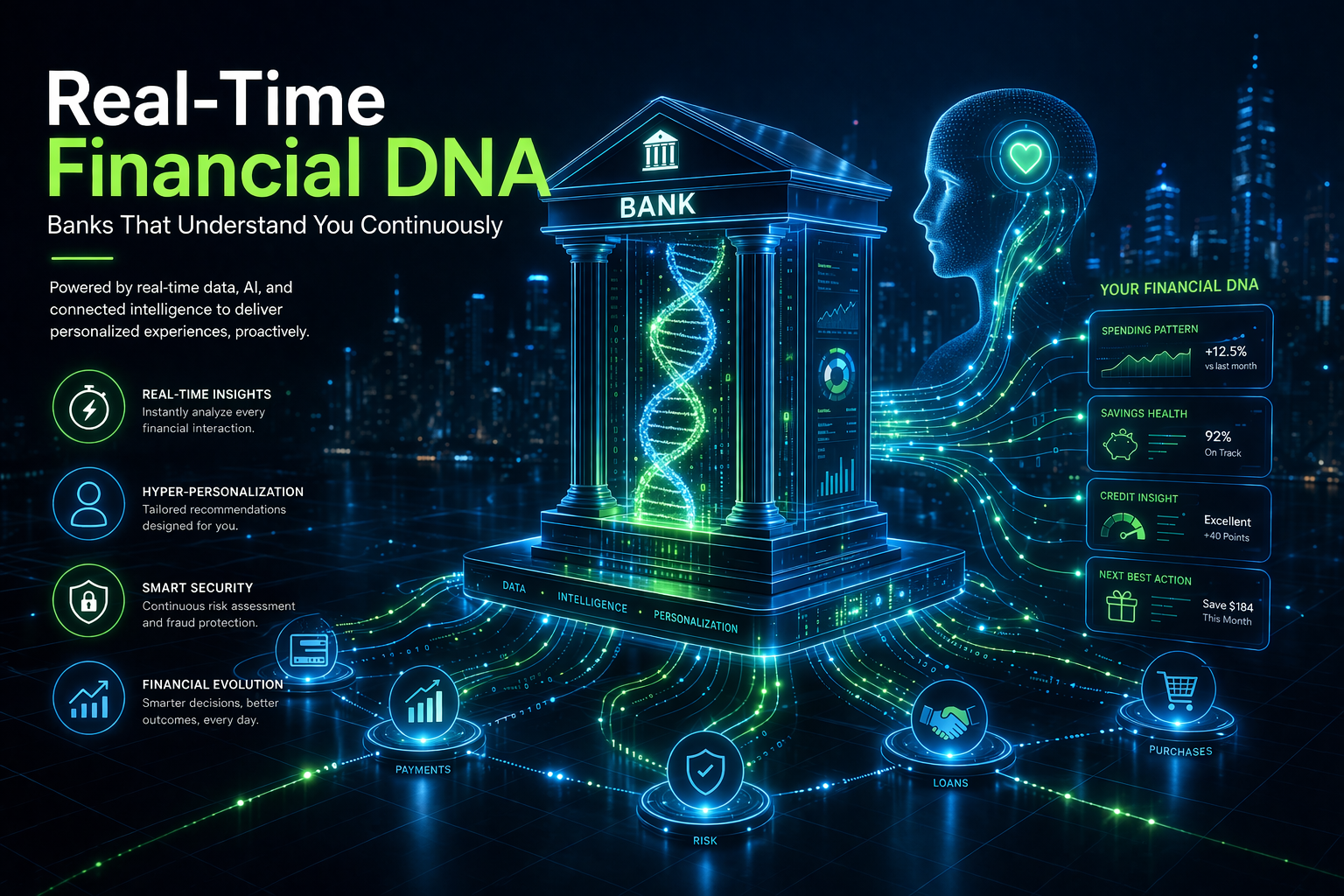
Real-Time Financial DNA: Banks That Understand You Continuously
For most of modern banking history, understanding a customer has been a static exercise. A snapshot taken at onboarding. A credit score updated periodically. A transaction history reviewed after the fact. Even as digital banking improved access and speed, the underlying model remained the same—banks reacted to what had already happened.
But a new paradigm is emerging—one where banks don’t just observe customers intermittently, but understand them continuously. This is what can be called “Real-Time Financial DNA”: a living, evolving profile of a person’s financial behavior, intent, and needs, updated moment by moment.
It is not a database. It is not a credit file. It is a dynamic system—one that learns, adapts, and anticipates.
At its core, Real-Time Financial DNA is built on continuous data streams. Every transaction, every behavioral signal, every contextual input contributes to a constantly updating financial identity. Unlike traditional models that rely on historical data, this system operates in real time, interpreting patterns as they emerge rather than after they are complete.
Imagine a bank that doesn’t wait for your account balance to drop before offering support. Instead, it detects subtle changes—slightly higher spending, irregular income timing, shifting patterns—and adjusts your financial environment proactively. It may suggest liquidity options, adjust credit availability, or optimize payment schedules automatically.
This is not just personalization. It is adaptation.
Artificial intelligence plays a central role in enabling this shift. Machine learning models can analyze vast amounts of transactional and behavioral data, identifying patterns that are invisible to human analysts. More importantly, they can do this continuously, updating their understanding in real time.
In this model, your financial identity is no longer defined by static attributes like income or credit score. It is defined by behavior—how you earn, spend, save, and interact with financial systems over time. This creates a richer, more nuanced understanding of financial health.
For example, two individuals with identical incomes and credit scores may have completely different financial behaviors. One may have stable spending patterns and consistent savings, while the other may exhibit volatility and risk. Traditional systems treat them similarly; Real-Time Financial DNA does not.
The implications for credit are profound. Lending decisions can move from periodic assessments to continuous evaluation. Instead of applying for a loan and waiting for approval, individuals could have dynamic credit access that adjusts in real time based on their financial behavior.
This reduces friction for consumers and risk for lenders. Credit becomes fluid rather than fixed—available when needed, scaled appropriately, and priced based on current conditions rather than outdated snapshots.
Payments, too, become more intelligent. A system that understands your financial DNA can optimize how and when payments are made. It can prioritize essential expenses, delay non-critical ones, or route transactions through the most cost-effective channels.
Savings and investments can also become adaptive. Instead of requiring users to set goals manually, systems can allocate funds automatically based on real-time conditions. Surplus income can be redirected into savings or investments instantly, while maintaining liquidity for upcoming expenses.
This creates a financial environment that is not just reactive, but self-regulating.
However, the concept of Real-Time Financial DNA raises important questions about privacy and control. Continuous monitoring of financial behavior requires access to sensitive data. Users must trust that this data is being handled securely, ethically, and transparently.
The challenge is to balance intelligence with privacy. Systems must be designed to extract insights without exposing unnecessary data, and users must have visibility into how their information is being used. Technologies like privacy-preserving computation and zero-knowledge systems may play a role in achieving this balance.
There is also the question of agency. If financial systems become too autonomous, users may feel a loss of control. It is essential that these systems remain assistive rather than directive—offering recommendations and automation while allowing users to override decisions when needed.
From a regulatory perspective, Real-Time Financial DNA challenges existing frameworks. Financial regulation is built around periodic reporting and discrete decisions. Continuous, adaptive systems require new approaches to oversight, accountability, and risk management.
For banks, this shift represents both an opportunity and a transformation. Institutions that embrace real-time intelligence can move from being service providers to becoming financial partners—systems that actively support and optimize their customers’ financial lives.
This also changes the competitive landscape. Technology companies and fintech platforms, with their expertise in data and AI, are well-positioned to lead this transformation. Traditional banks must evolve their infrastructure and mindset to keep pace.
The concept extends beyond individual consumers. Businesses can also benefit from real-time financial intelligence. Cash flow management, risk assessment, and investment decisions can all be optimized continuously, creating more resilient and efficient operations.
In the long term, Real-Time Financial DNA could redefine financial inclusion. Traditional systems often exclude individuals with limited credit history or irregular income. Continuous behavioral analysis can provide alternative signals of financial reliability, enabling more inclusive access to credit and services.
This is particularly important in emerging markets, where large segments of the population remain underserved by traditional banking. By focusing on real-time behavior rather than historical records, financial systems can better reflect the realities of modern economic life.
Yet, as with any powerful technology, there are risks. Bias in data or algorithms can lead to unfair outcomes. Over-reliance on automation can create systemic vulnerabilities. Ensuring fairness, transparency, and resilience will be critical as these systems evolve.
Ultimately, Real-Time Financial DNA represents a shift from episodic banking to continuous financial intelligence. It is a move away from static profiles toward living systems that understand and adapt to individuals in real time.
In this future, banking is no longer something you interact with occasionally. It becomes an ongoing relationship—one where your financial system is always aware, always responsive, and always working in the background to support your goals.
The question is no longer whether banks can understand you. It is whether they can understand you continuously—and whether they can do so in a way that earns your trust.