
Invisible Banking: Financial Services Without Apps or Interfaces
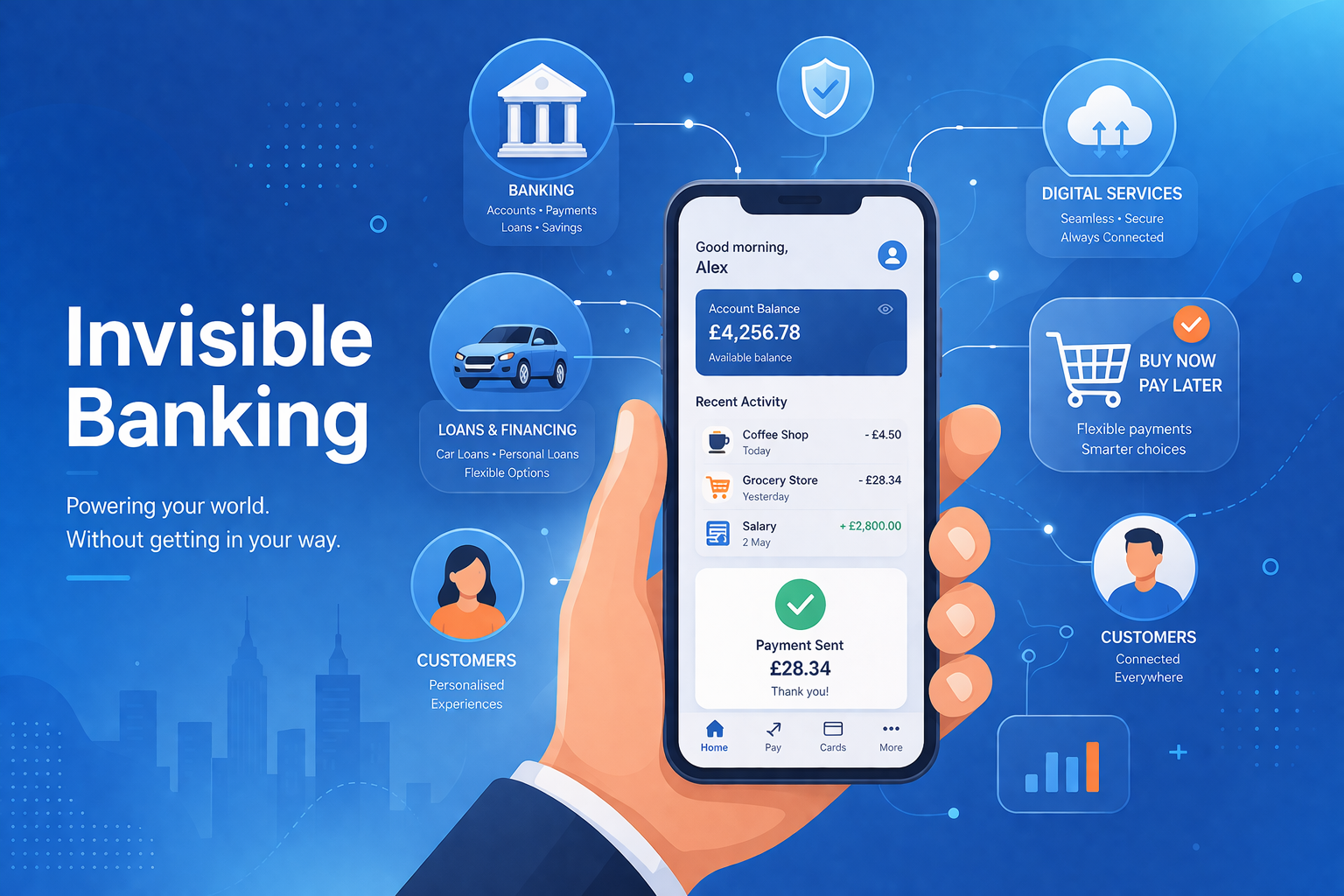
For years, the evolution of banking has been measured by better interfaces. First came online banking portals, then mobile apps, then sleek dashboards powered by AI. Each generation promised more convenience, faster access, and smarter insights. But a quiet shift is now underway—one that challenges the very idea of banking as something you actively “use.”
Welcome to invisible banking: a world where financial services no longer live inside apps or interfaces, but are embedded seamlessly into everyday experiences. In this model, banking doesn’t disappear—it dissolves into the background, operating quietly, intelligently, and automatically whenever needed.
The most important thing about invisible banking is that you don’t notice it. There is no login screen, no balance check, no deliberate action. Instead, financial decisions and transactions happen contextually, triggered by behavior, intent, or real-world events. The result is a system where money moves as naturally as information does today.
This shift is being driven by a convergence of technologies—AI, embedded finance, APIs, digital identity, and real-time payments. Together, they are transforming banking from a destination into an infrastructure layer. Just as users no longer think about the internet when they stream a video or send a message, they may soon stop thinking about banking when they pay, borrow, or invest.
Consider how payments have already evolved. A ride booked through a mobility platform is paid for automatically at the end of the trip. A subscription renews without intervention. A food delivery order is charged seamlessly. In each case, the financial transaction is real, but the banking experience is invisible. The app is not a bank, but it performs a banking function.
This is only the beginning. Invisible banking extends far beyond payments. Lending, insurance, savings, and even wealth management are being embedded directly into workflows and digital environments. A small business platform can offer working capital the moment cash flow dips. An e-commerce site can provide instant credit at checkout. A payroll system can automatically allocate income into savings and investments without requiring user input.
What makes this possible is the rise of embedded finance—where financial services are integrated into non-financial platforms through APIs. Companies no longer need to build banks; they can plug into banking capabilities and deliver them within their own ecosystems. This has blurred the line between financial institutions and technology platforms, creating a new competitive landscape.
Artificial intelligence is the other critical ingredient. While embedded finance provides the infrastructure, AI provides the intelligence that makes banking truly invisible. It can anticipate needs, analyze behavior, and make decisions in real time. Instead of asking users what they want, systems can infer intent and act accordingly.
Imagine a scenario where your financial system detects that your monthly expenses are rising and automatically adjusts your budget, shifts funds from savings, or suggests cost-saving actions—all without requiring you to open an app. Or a system that notices a potential fraud risk and blocks a transaction before you even realize something is wrong.
In this world, the interface becomes optional. The primary interaction is not through screens, but through outcomes. Banking is no longer something you manage—it is something that manages itself on your behalf.
This transformation also reflects a deeper change in consumer expectations. People increasingly value convenience, speed, and simplicity. They do not want to navigate complex financial tools or make constant decisions about routine matters. Invisible banking aligns with this mindset by reducing friction and cognitive load.
However, removing interfaces does not mean removing control. One of the key challenges of invisible banking is ensuring that users remain informed and empowered. Transparency must be built into the system, even if it is not front and center. Users should be able to understand what is happening, why decisions are being made, and how to intervene when necessary.
Trust becomes even more critical in this context. When financial services operate in the background, users must have confidence that the system is acting in their best interest. This requires strong governance, clear accountability, and robust safeguards. It also raises important questions about data privacy and security, as invisible banking relies heavily on personal and behavioral data.
Regulation will play a significant role in shaping this future. Traditional regulatory frameworks are designed around visible institutions and explicit transactions. Invisible banking challenges these assumptions, as financial activities become distributed across platforms and automated processes. Regulators will need to adapt to ensure consumer protection without stifling innovation.
For banks, this shift presents both a threat and an opportunity. On one hand, the traditional model of attracting customers through branded apps and interfaces is being disrupted. If banking becomes invisible, brand visibility may diminish. On the other hand, banks can position themselves as infrastructure providers, powering financial services behind the scenes.
Some institutions are already moving in this direction, offering Banking-as-a-Service (BaaS) platforms that enable other companies to embed financial capabilities. In this model, the bank is no longer the front-end experience, but the engine that makes the experience possible.
Technology companies, meanwhile, are becoming the new front doors to financial services. Platforms with large user bases—whether in e-commerce, mobility, or social media—are uniquely positioned to integrate financial functions into their ecosystems. This gives them a powerful advantage in capturing user engagement and data.
The rise of programmable money, including stablecoins and central bank digital currencies, could further accelerate invisible banking. These technologies enable transactions to be executed automatically based on predefined conditions, without manual intervention. Money itself becomes an active participant in the system, capable of responding to context and logic.
In such a world, financial services become event-driven rather than user-driven. A payment is triggered when a service is delivered. A loan is issued when a need is detected. An investment is made when surplus funds are available. The system operates continuously, adapting to changing circumstances in real time.
There are also implications for financial inclusion. Invisible banking has the potential to reach users who may not engage with traditional banking interfaces. By embedding financial services into platforms people already use, it can lower barriers to access and bring more individuals into the financial system.
At the same time, there is a risk of exclusion if systems become too opaque or reliant on digital infrastructure. Ensuring accessibility and fairness will be essential to avoid creating new forms of inequality.
Ultimately, invisible banking represents a shift from interaction to integration. It is not about making banking better—it is about making it disappear into the fabric of everyday life. This does not diminish its importance; it enhances it by making financial services more responsive, efficient, and aligned with real-world needs.
The future of banking may not be something you see on your phone. It may be something you feel in the smoothness of your daily experiences—the absence of friction, the absence of delay, the absence of effort.
And in that absence, a new kind of financial system emerges—one that is always present, always working, and almost entirely invisible.