Invisible Banking – Banking Without Apps
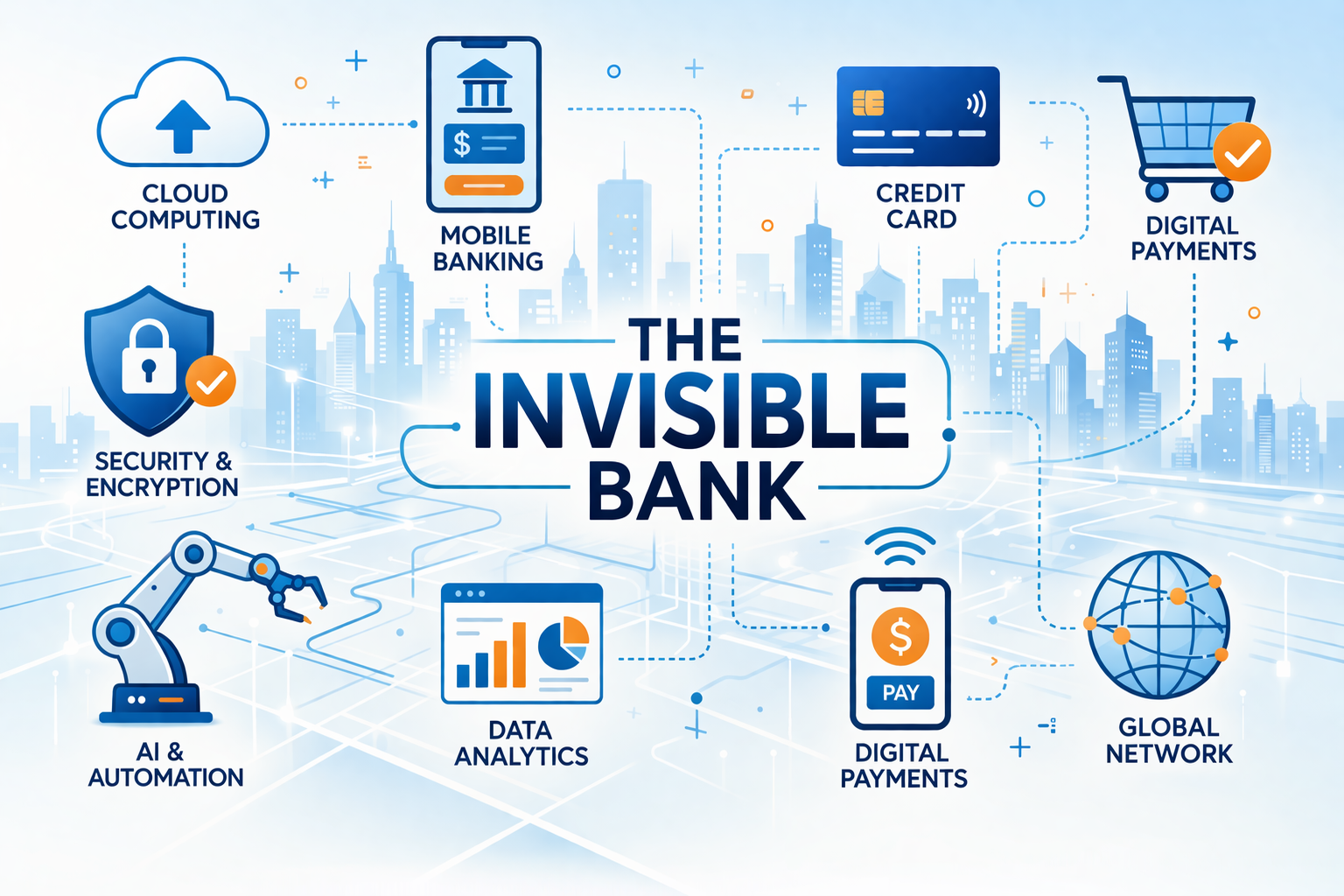
Invisible banking is one of the most important emerging trends in financial technology. The idea behind invisible banking is simple: banking services happen in the background, automatically, without the user opening a banking app, visiting a bank website, or even thinking about a bank at all. Payments, lending, insurance, and financial management are built directly into platforms, devices, and software that people already use every day. The bank becomes a hidden infrastructure layer rather than a visible destination.
For decades, banking has required customers to go to the bank. First physically through branches, then digitally through mobile banking apps and websites. Invisible banking represents the next stage of this evolution. In this model, customers do not go to the bank; the bank comes to the customer, embedded inside other services. This is why invisible banking is often closely connected with embedded finance, fintech platforms, and digital ecosystems.
A simple example of invisible banking is ride-hailing apps. When a person books a ride, the payment happens automatically in the background. The user does not open a banking app to transfer money. The fare is deducted automatically from a card, wallet, or account. Another example is e-commerce platforms where customers can buy products using “Buy Now, Pay Later” options. The loan is approved instantly in the background, the payment is processed, and the customer experiences the entire process as a simple checkout rather than a banking transaction. In both cases, banking services such as payments and lending are present, but they are invisible to the user.
The growth of invisible banking is driven by technology such as APIs (Application Programming Interfaces), cloud computing, artificial intelligence, and real-time payment systems. APIs allow banks to connect their services with other platforms such as e-commerce websites, mobile apps, accounting software, and business tools. This concept is often called Banking-as-a-Service (BaaS). Through BaaS, a company that is not a bank can still offer banking services like payments, wallets, loans, or cards by connecting to a licensed bank’s infrastructure.
Artificial intelligence also plays a major role in invisible banking. AI systems can analyze customer behavior, income patterns, spending habits, and risk profiles to make instant financial decisions. For example, a system can automatically approve a small loan when it detects that a customer has a regular salary and good repayment history. Similarly, AI can automatically move money into savings, pay bills, or invest funds based on predefined rules. In this way, financial management becomes automated and happens without manual action from the user.
One of the biggest advantages of invisible banking is convenience. Customers do not want to manage multiple banking apps, payment apps, investment apps, and loan apps. They prefer financial services to be integrated into the platforms they already use. Invisible banking reduces friction in financial transactions and makes payments and financial services faster and easier.
Another advantage is that invisible banking allows businesses to offer financial services to their customers. For example, an e-commerce company can offer instant credit at checkout, a logistics platform can offer working capital loans to drivers, and a software platform can offer integrated payments and automated accounting. This creates new revenue streams for businesses and new financial access for customers who may not use traditional banking services.
However, invisible banking also raises important questions about data privacy, security, and regulation. Since financial services are embedded into non-banking platforms, large technology companies and fintech platforms gain access to financial data. Regulators must ensure that customer data is protected and that companies offering embedded financial services follow financial regulations.
Another challenge is that customers may not always know which financial institution is actually providing the service. For example, when a customer uses a wallet inside a shopping app, the actual banking service may be provided by a partner bank in the background. This makes transparency and regulation very important in invisible banking systems.
Despite these challenges, invisible banking is growing rapidly around the world. Real-time payment systems, open banking regulations, embedded finance platforms, and digital wallets are all contributing to this shift. In the future, banking may become something that people rarely think about directly. Instead of opening a banking app, people will interact with financial services through shopping platforms, transport apps, business software, smart devices, and even IoT systems.
Invisible banking represents a shift from “banking as a place” to “banking as a function.” The bank is no longer just an institution where people store money. It becomes a financial engine that operates quietly in the background, powering transactions, credit, savings, and investments across digital platforms.
In simple terms, the future of banking may not be an app at all. It may be a system that works automatically in the background, embedded into everyday life, where payments, loans, insurance, and investments happen instantly and invisibly. That is why invisible banking is often described as the future of finance — a world where financial services are available everywhere, but the bank itself is nowhere to be seen.