Zero-Knowledge UX: Making Privacy Invisible to Users
Privacy has long been treated as a feature—something users must actively configure, manage, and sometimes even sacrifice convenience to maintain. We’ve grown accustomed to toggling settings, accepting cookie banners, and navigating complex permission screens, all in the name of protecting our data. But what if privacy didn’t require effort? What if it simply existed by default, embedded so deeply into systems that users never had to think about it at all?
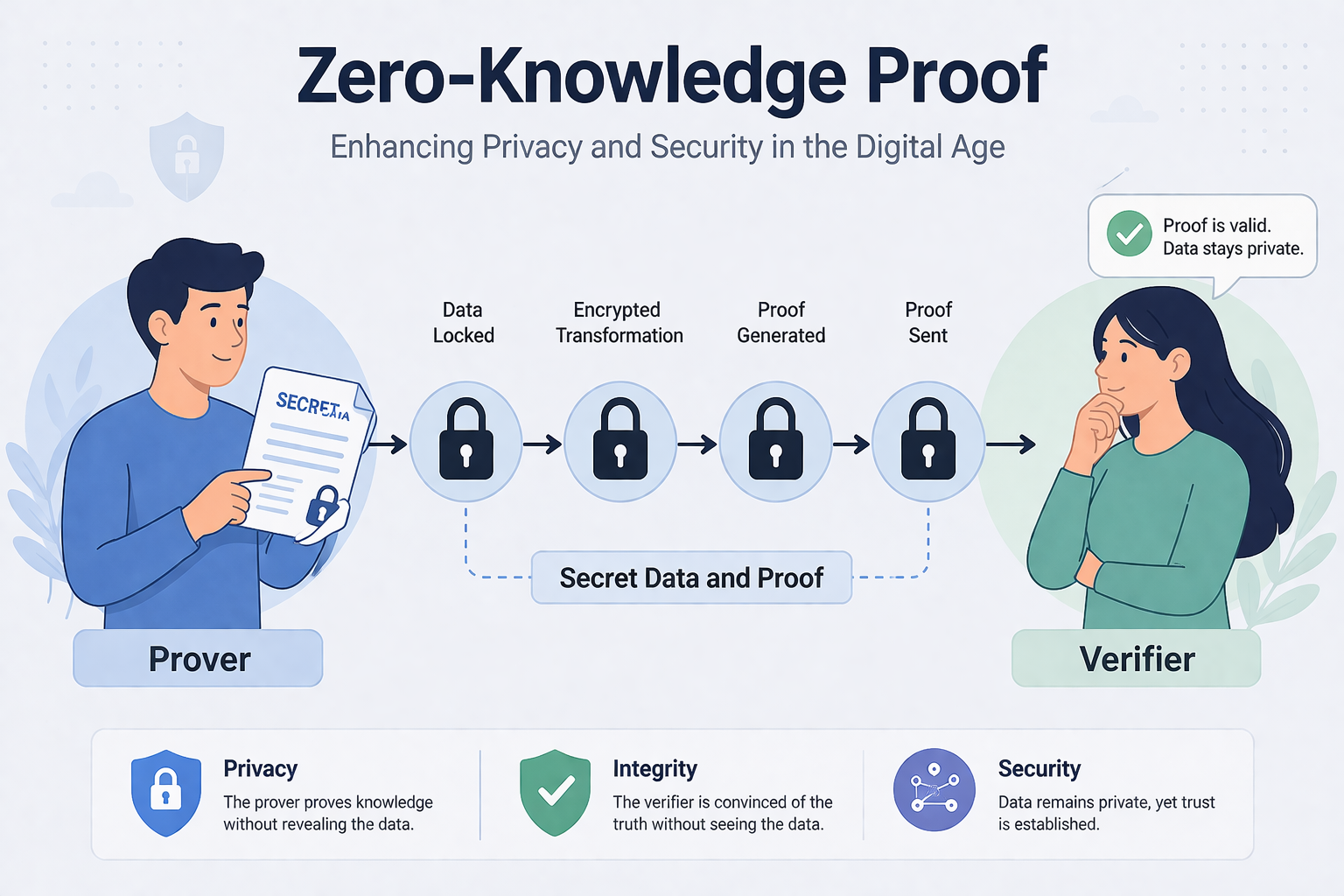
This is the promise of Zero-Knowledge UX: a design paradigm where privacy is not a visible layer of control, but an invisible guarantee. It is powered by cryptographic techniques—particularly zero-knowledge proofs—that allow systems to verify information without exposing the underlying data. In this model, users don’t need to manage privacy; the system enforces it automatically.
At its core, a zero-knowledge system allows one party to prove something is true without revealing why it is true. You can prove you are over 18 without sharing your birthdate. You can verify you have sufficient funds without exposing your account balance. You can authenticate your identity without transmitting sensitive credentials. The interaction becomes minimal, precise, and secure by design.
What makes Zero-Knowledge UX transformative is not just the technology, but how it reshapes the user experience. Traditionally, privacy and usability have been in tension. Stronger privacy often meant more friction—extra steps, slower processes, or limited functionality. Zero-knowledge systems challenge this trade-off by enabling privacy-preserving interactions that are as seamless as their less secure counterparts.
Imagine logging into a service without a password, without biometrics being stored, and without any personal data being transmitted. The system verifies your identity cryptographically, and access is granted instantly. From the user’s perspective, it feels effortless. Behind the scenes, however, a complex proof ensures that your identity is valid without ever exposing it.
This invisibility is key. Users should not need to understand cryptography to benefit from it. Just as people use HTTPS without thinking about encryption protocols, Zero-Knowledge UX aims to make advanced privacy protections part of the default experience. The goal is not to educate users about privacy—it is to remove the burden of managing it altogether.
One of the most compelling applications of Zero-Knowledge UX is in digital identity. Today, identity verification often involves sharing excessive amounts of information. A simple transaction might require uploading documents, entering personal details, and trusting that the recipient will store that data securely. This creates risk at every step.
With zero-knowledge systems, identity becomes selective and minimal. Users can prove specific attributes—age, residency, membership—without revealing anything beyond what is անհրաժեշտ. This reduces data exposure and minimizes the risk of breaches. It also aligns with emerging privacy regulations that emphasize data minimization and user control.
Financial services stand to benefit significantly from this approach. Know Your Customer (KYC) processes, for example, could be transformed. Instead of repeatedly submitting documents to different institutions, users could generate reusable proofs that confirm compliance without exposing raw data. Transactions could be validated instantly, securely, and privately.
Payments are another area where Zero-Knowledge UX can have a profound impact. In traditional systems, transactions often reveal more information than necessary—who paid whom, how much, and when. Zero-knowledge techniques can enable transactions that are verifiable without being fully transparent, preserving both integrity and privacy.
However, the shift to invisible privacy is not without challenges. One of the primary concerns is trust. When privacy mechanisms are hidden, users must trust that they are working as intended. This places a greater responsibility on developers, auditors, and regulators to ensure that systems are secure, transparent in their design, and accountable in their operation.
There is also the question of performance. Zero-knowledge proofs, while powerful, can be computationally intensive. Advances in cryptography and hardware are rapidly improving efficiency, but integrating these systems into real-time applications at scale remains a technical challenge.
Another consideration is user awareness. While the goal is to make privacy invisible, users should still have the ability to understand and control their data if they choose to. This requires thoughtful design—interfaces that are simple by default but offer deeper insights when needed. Transparency does not have to mean complexity; it can be layered and optional.
From a business perspective, Zero-Knowledge UX represents a shift in how value is created. Instead of monetizing user data, companies can build trust by minimizing data collection altogether. This could lead to new models of engagement, where privacy becomes a competitive advantage rather than a compliance requirement.
Regulation will play a crucial role in accelerating this transition. As governments around the world introduce stricter data protection laws, the ability to prove compliance without exposing data becomes increasingly valuable. Zero-knowledge systems offer a way to meet regulatory requirements while enhancing user experience.
The broader implication of Zero-Knowledge UX is a redefinition of digital interaction. In today’s internet, data is often the price of participation. Users exchange personal information for access to services, creating a continuous flow of data that is stored, analyzed, and sometimes exploited. Zero-knowledge systems disrupt this model by enabling interactions that do not require data exchange.
This has profound consequences for how trust is established online. Instead of trusting organizations to protect data, users can rely on systems that never collect it in the first place. Trust shifts from institutions to protocols, from policies to mathematics.
As this paradigm gains traction, we may see a future where privacy is no longer a concern because it is no longer a variable. It is simply part of the infrastructure, like electricity or connectivity—always present, rarely noticed, and fundamentally essential.
Zero-Knowledge UX is not about adding more privacy features; it is about removing the need for them. It is about designing systems where the safest option is also the easiest, where users are protected by default, and where privacy is not a choice but a condition.
In that world, the most powerful privacy tool will not be something users configure or even see. It will be something they never have to think about at all.